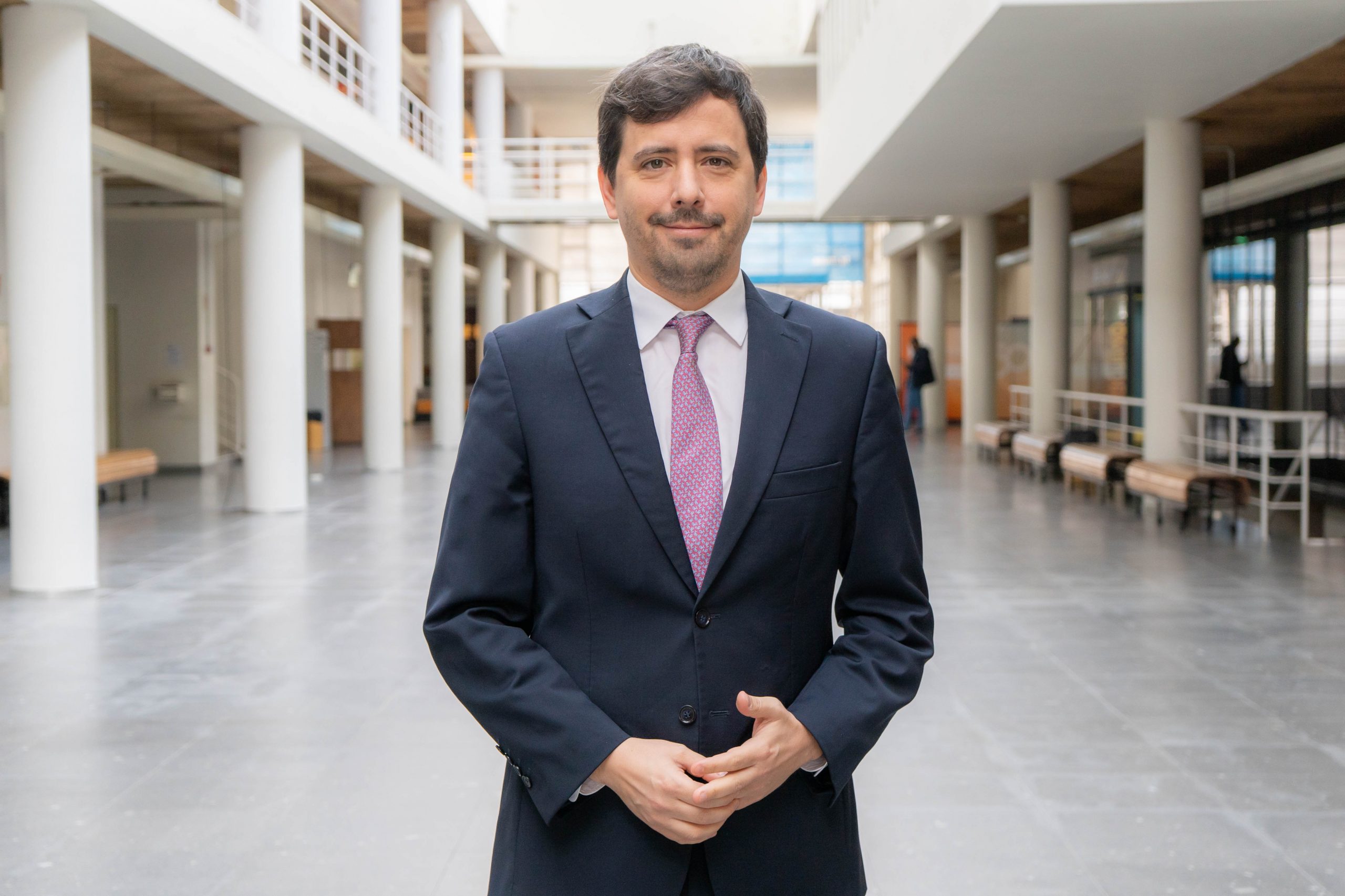
 Cycle of interviews with the members of the new Advisory Board of the School of Engineering. In this edition we interviewed Dr. João Rodrigues, Mayor of Braga.
The Advisory Board of the School of Engineering of the University of Minho (EEUM) is the advisory body of the School’s governing bodies for matters of strategic definition. Composed of nine personalities external to the institution, of recognized merit in the areas of their activity, their mission is to pronounce on matters of a pedagogical, scientific nature and interaction with society.
1. How did you receive the invitation to join the Advisory Board of the School of Engineering of the University of Minho and what meaning do you attribute to this connection, as Mayor of Braga?
I received the invitation with great honour and with a deep sense of institutional responsibility. This integration has a very clear meaning: it is the practical consecration of the conviction that local government and academia do not walk in parallel, but hand in hand. As Mayor of Braga, I see this seat on the Advisory Board as the recognition that the development of our territory requires a permanent bridge with scientific knowledge. The School of Engineering is an integral part of our region’s innovation, and being present in this body allows us to align, from the beginning, the city’s growth strategies with the excellence of teaching and research that are produced here.
2. As Braga is a city deeply linked to knowledge, innovation and university presence, how do you see the role of a representative of local government in a strategic advisory body such as the EEUM Advisory Board?
The role of local government in this body is to bring the “voice of the territory” and the perspective of practical application. Municipalities are today living laboratories where social, economic, environmental and urban challenges are manifested with all intensity. The municipality’s contribution is to help direct research and training to the real needs of the community, ensuring that the knowledge generated at the EEUM translates into smarter public policies, greater competitiveness for our companies and concrete answers for the quality of life of citizens. Our presence serves to anchor the academic strategy in the economic and social reality of Braga.
3. In your perspective, how can the proximity between the School of Engineering and the Municipality of Braga contribute to a more integrated vision of the development of the city, the region and the university itself?
It contributes through what I call governance based on knowledge and evidence. When the municipality and the School of Engineering cooperate closely, we can anticipate the future. This can be seen in urban planning, energy transition, smart mobility and the dynamism of the business fabric. A city that plans its growth by articulating the new PDM, the expansion of land for economic activities and research centers guarantees sustainable development, generating qualified employment and capable of retaining talent. The integration of these visions benefits the university, which gains regional impact, and benefits the region, which is at the forefront of innovation.
4. As a mayor, what kind of contribution would you like to make, through this body, to strengthen the connection between the EEUM and the territory where an important part of its activity is developed?
I would like to leave the testimony of a partnership without barriers, where science and municipal management dialogue daily. My contribution is to encourage agile mechanisms for knowledge transfer, namely support for applied projects, living laboratories and technology-based incubation, ensuring that the skills of the nine departments of the EEUM are also mobilized to solve concrete problems in Braga. I want the School of Engineering to feel the City Council not only as a partner institution, but as a natural extension of its mission to transform society through engineering.
5. In the next three years, in which areas do you think the Municipality of Braga can collaborate more closely with the School of Engineering to strengthen the city’s attractiveness as a space for training, innovation and retention of qualified talent?
Braga’s attractiveness is made through a complete ecosystem: affordable housing, efficient mobility, quality of life and professional opportunities. In the coming years, the Municipality can collaborate decisively in creating conditions to retain the engineers we train. This involves structuring projects such as the expansion of business land, support for Startup Braga and InvestBraga, and the development of initiatives such as the BioMedTech Hub. We want to ensure that young graduates of the EEUM find an increasingly dynamic job market in Braga, with innovative companies and qualified salaries, making it unnecessary to look for opportunities outside the country.
6. Taking into account the presence, in Braga, of strategic areas of the EEUM such as Computer Engineering and Chemical and Biological Engineering, what opportunities do you identify to deepen the articulation between the School, the Municipality and the most innovative sectors in the territory?
The opportunities are immense and are at the heart of our future strategy. In the area of Computer Engineering and Information Systems, the Municipality is strongly committed to digital transformation, artificial intelligence applied to public management and the dematerialization of processes, where the collaboration of the EEUM can play an invaluable role. In the field of Chemical and Biological Engineering, as well as Polymers and Textiles, we have the perfect example in the future BioMedTech Hub and in the circular economy and energy transition plans. The articulation involves crossing the cutting-edge research of these departments with the industrial fabric of Braga, promoting product innovation, environmental sustainability and technological sovereignty.
7. What role can a municipality like Braga play in supporting the EEUM’s objectives in terms of quality of student life, mobility, internationalization, entrepreneurship and connection to the economic and institutional fabric of the city?
The municipality must assume itself as the catalyst for the quality of life of the academic community. In terms of mobility, we have a broad and very ambitious vision for the future: we are strongly committed to the continuous qualification of Braga’s Urban Transport (TUB), the reformulation and optimization of lines to better serve university campuses , the creation of dedicated corridors that remove cars from the main arteries and the absolute prioritization of public transport and soft modes. In housing we have a perfect example of cooperation: the University Residence of Fábrica Confiança. In entrepreneurship and internationalization, the ecosystem led by InvestBraga and Startup Braga works as the perfect bridge to project EEUM’s talent in global markets.
8. If you had to highlight two or three priority initiatives that Braga and the EEUM could develop together in the next three years, which ones would you choose to generate the greatest impact on the city, on the students and on the projection of the School?
First, to deepen the Living Laboratories of Sustainability and Urban Innovation, directly applying the research of the departments of Civil Engineering, Production and Systems and Industrial Electronics to the real challenges of public space, traffic management and energy efficiency in Braga.
Second, to optimize the municipality’s transport network and smart mobility, crossing the technical knowledge of academia with our strategy of qualifying the TUB, reformulating lines and creating dedicated axes that remove car traffic from the center and ensure fast and sustainable travel for students.
Third, to reinforce the integrated strategy of attracting and retaining talent, uniting the training offer of the EEUM, the BioMedTech Hub and the municipal qualified employment programs, ensuring that Braga consistently asserts itself as the city of knowledge and engineering.