Leaders from the country’s leading export sector gathered on 27 May in Guimarães
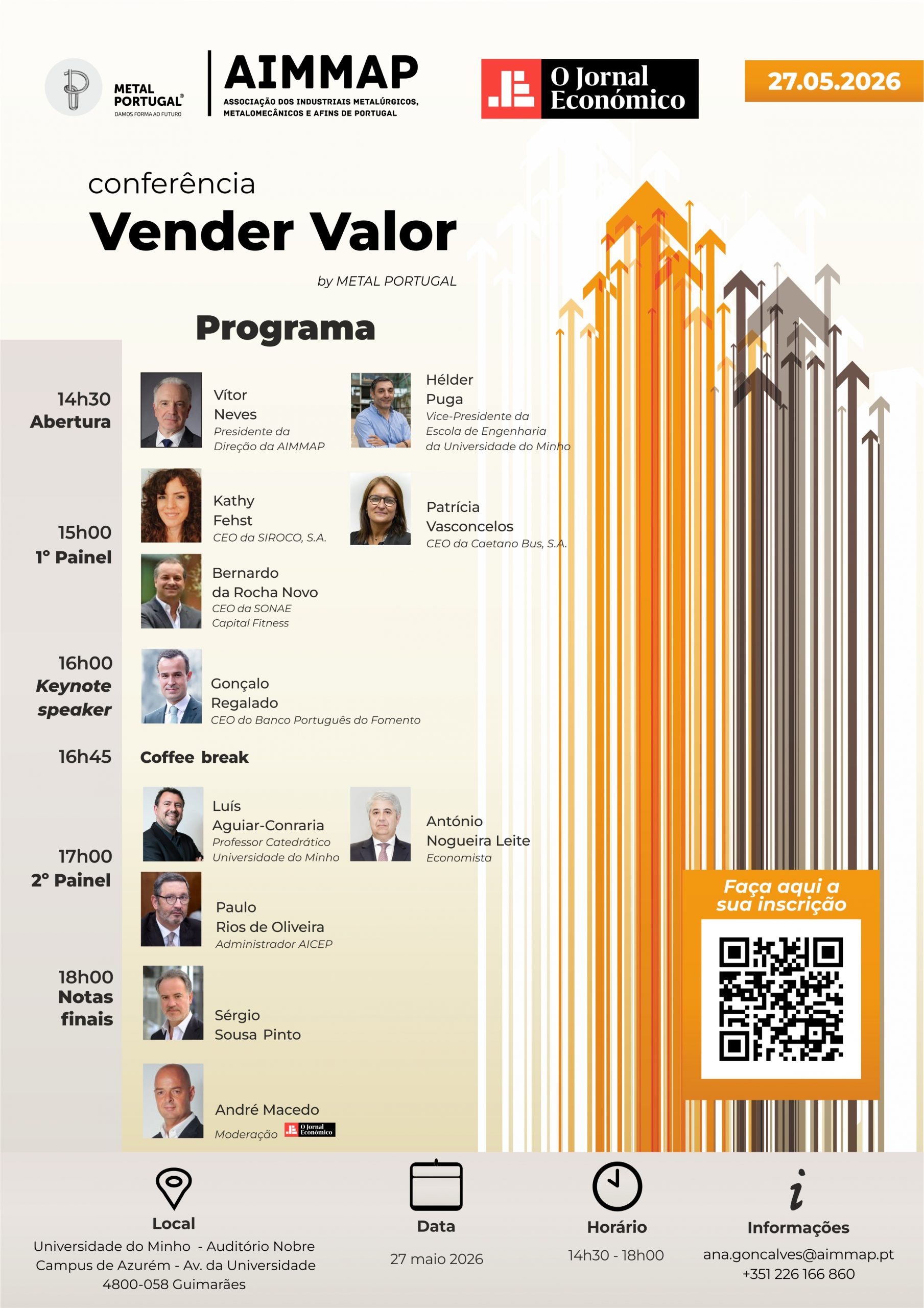
The metallurgical and metalworking sector accounts for a third of the country’s industrial exports and generates 250,000 jobs. Its future was the subject of debate on 27 May in the main auditorium of the University of Minho in Guimarães. This was the Annual Conference of AIMMAP (Association of Metallurgical, Metalworking and Related Industries of Portugal), with the theme “Selling value”. In practice, the sector now seeks to distinguish itself through innovation, technology and added value, definitively moving away from low-cost competitiveness.
The event opened with speeches by the president of AIMMAP, Vítor Neves, and the vice-president of the School of Engineering at UMinho, Hélder Puga. The first panel brought together the managing directors of Siroco, Caetano Bus and Sonae Capital Fitness, namely Kathy Fehst, Patrícia Vasconcelos and Bernardo da Rocha Novo. The keynote speech took place at 4.00 pm and was delivered by the CEO of Banco Português do Fomento, Gonçalo Regalado.
This was followed by a panel discussion featuring Vítor Neves, the director of AICEP (Portuguese Agency for Investment and Foreign Trade), Paulo Rios de Oliveira, and the president of the School of Economics, Management and Political Science at UMinho, Luís Aguiar-Conraria. The session was moderated by André Macedo, director of O Jornal Económico, a partner in the event. The conference’s conclusions were presented by Sérgio Sousa Pinto, a commentator for CNN Portugal.
The initiative focused on the challenges of internationalisation, financing, productivity and industrial skills. This sector is highly competitive abroad and is projected to reach a record €24.2 billion in exports by 2025. Indeed, it is considered strategic for European reindustrialisation, the energy transition, defence, the digitalisation of the economy and the industry-science link. The main pressures on the sector are geopolitical instability, energy and raw material costs, competition from less demanding markets, supply chains and decarbonisation. To sell into highly sophisticated markets, Portugal has also been innovating. For example, the scientific-business consortium PRODUTECH R3 is set to launch 85 new products and services.