247 participants from 35 countries gathered in Guimarães to discuss the future of open-source computational simulation
Ten years after it was first held in Guimarães, the international OpenFOAM community returned to the city for the 21st OpenFOAM Workshop (OFW21), which took place between 29 June and 3 July at the Vila Flor Cultural Centre, as part of the European Green Capital 2026 programme.
The OpenFOAM Workshop is the world’s leading conference dedicated to OpenFOAM, the most widely used open-source, freely available computational simulation software. Developed collaboratively by thousands of researchers, engineers and companies around the world, OpenFOAM enables the simulation of complex phenomena related to fluid flow, heat transfer, combustion, aerospace, automotive, energy, the environment, biomedical engineering, polymer processing and many other areas of science and engineering.
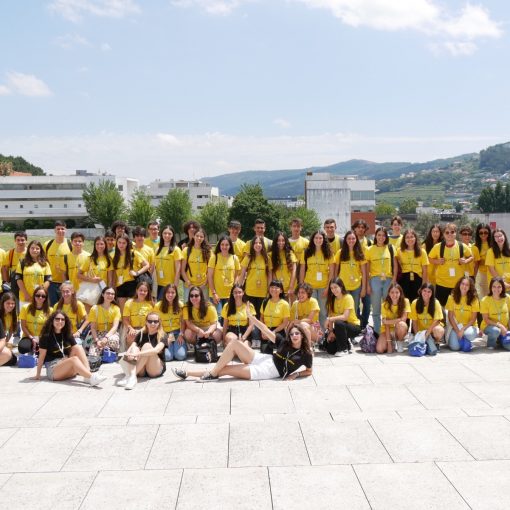
OFW21 brought together 247 participants in Guimarães, from 35 countries, representing 137 institutions across five continents, including universities, research centres and world-leading companies in engineering and technological development.
Throughout the week, the latest scientific and technological advances related to OpenFOAM were presented, promoting knowledge sharing between academia and industry and reinforcing the role of international collaboration in the development of open-source scientific software.
OpenFOAM Hackathon challenges participants to improve air quality in Guimarães
Running alongside the conference was the OpenFOAM Hackathon, an intensive collaborative development initiative that began on 15 June with a week dedicated to advanced training in OpenFOAM, programming, high-performance computing (HPC), machine learning and urban flow simulation.
Following this preparatory phase, four multidisciplinary teams competed to respond to a challenge set by the organisers: to quantify the impact that different sustainable mobility strategies might have on air quality in Guimarães.
To this end, a detailed computational model of the city was developed, using its three-dimensional urban geometry and real-world road traffic data, enabling the creation of a baseline against which different emission reduction scenarios are being assessed.
The results made it possible to estimate, amongst other things, the improvement in air quality in particularly sensitive areas, such as schools and the city’s hospital.
Presentation of the results
The four teams presented the final results of the Hackathon on 3 July, in the Small Auditorium of the Vila Flor Cultural Centre.
The session formed part of the official programme of the OpenFOAM Workshop and provided an opportunity to learn about the various solutions developed, as well as the potential of computational simulation to support decision-making relating to urban mobility, sustainability and environmental quality.
The hosting of the 21st OpenFOAM Workshop in Guimarães reinforces the city’s international standing as a destination for major scientific and technological events, whilst promoting the link between research, innovation and sustainable development.
More info: https://openfoamworkshop.org/event_agenda