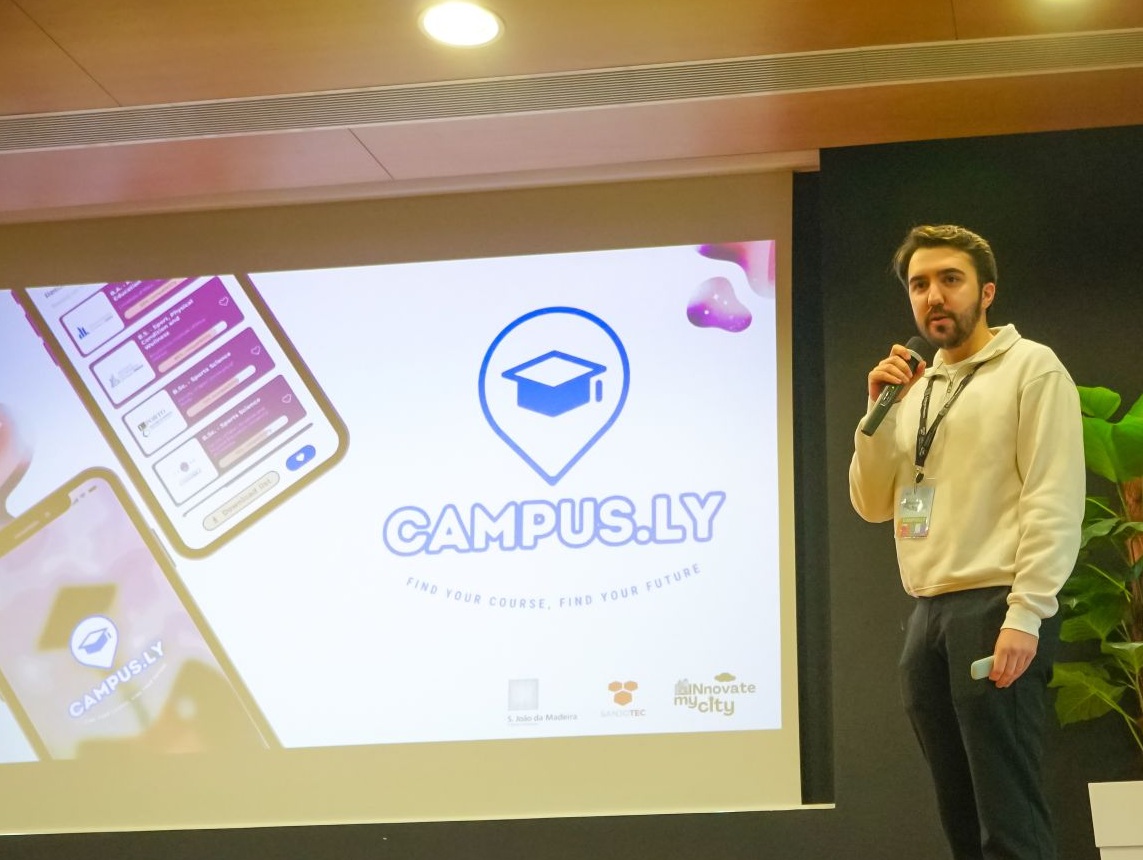
Campus.ly, developed by Samuel Anjos, is unique in that it cross-references students’ grades, exam results and profiles with geographical and financial filters – and was recently available to try out at the UMinho stand at the Qualifica fair, where EEUM was in attendance.
The University of Minho took part in Qualifica, the national education and employment fair, held at Exponor in Matosinhos from 25 to 28 March. Its academic offering includes 64 undergraduate courses (including five unique dual-degree programmes in the public education system) and 179 postgraduate courses across a wide range of disciplines. At its stand, visitors could try out a human-machine multimedia interface developed by Diogo Cunha, a member of EEUM’s Office of Communication and Interaction with Society and an alumnus of the Master’s in Interactive Technologies, and, in particular, an app that is a first in Portugal for higher education applicants.
The app is called Campus.ly, and its founder, Samuel Anjos, a PhD student in Computer Science at UMinho, will help the secondary school students present to cross-reference their exam results, subject areas, interests, locations and estimated costs, so they can identify the best course and institution to apply for. Developed mainly in the author’s spare time, the app stems from his direct experience as a student and his identification of a gap in the career guidance process.
The project has already won awards in innovation competitions organised by the National Association of Young Entrepreneurs, PortusPark/Youth Foundation and Sanjotec/Municipality of S. João da Madeira, where it is currently being incubated. The team comprises 12 members from various countries and is supported by the European Blended4Future project. The final version of the app will be released in June, just ahead of the national higher education entrance exams.
“Today, more than ever, it is crucial to choose the right course, whether for financial reasons such as accommodation or tuition fees, to avoid dropping out of studies, to avoid wasting a year switching fields, or to avoid feeling unfulfilled professionally later on,” says Samuel Anjos. “The transition from Year 12 to university causes a great deal of confusion and anxiety for students and parents, and, furthermore, it is important to complement the work of school psychologists; therefore, the new app fills a clear need in our society and helps thousands of young people make a more informed and quicker decision about their future,” adds the author.
Personalised recommendations
This app offers personalised recommendations, psychometric tests, comparisons of courses and public and private institutions, and dozens of filters to narrow down your search. It works by entering details such as exams taken, your grade average and your location, and you can quickly add other interests, ranging from sport to volunteering. A list of suitable universities and polytechnics then appears, including various filters such as tuition fees and nearby public transport. For the selected institution, you can also find out about its facilities, the course description and management, career prospects and direct contact details, for example.
The Campus.ly prototype has been tested over the last few months by secondary school pupils to optimise the content and correct errors. Later, the project aims to support students from as early as Year 9, when they choose their field of study in secondary school, but also to assist students in choosing master’s programmes or even those interested in pursuing higher education in Portugal, particularly through the Erasmus programme. For Samuel Anjos, the app also aims to serve as an inspiration, showcasing the value of local education, innovation and youth entrepreneurship.
Samuel Anjos was born 25 years ago in New York (USA) and lives in Gaia. He holds a bachelor’s degree in Marketing Management and a master’s degree in Digital Transformation from the University of Maia, where he is a visiting lecturer and founded Rise Up Junior Enterprise. As part of his PhD at the School of Engineering at UMinho, he has been conducting research in the field of immersive technologies and spatial computing applied to the healthcare sector. He has previously collaborated with the Belgian start-up Expect Me, the CEiiA technology centre, the European academic consortia AI ERIT and D-PBL, and the international conferences DeepLearn and ICMarkTech.