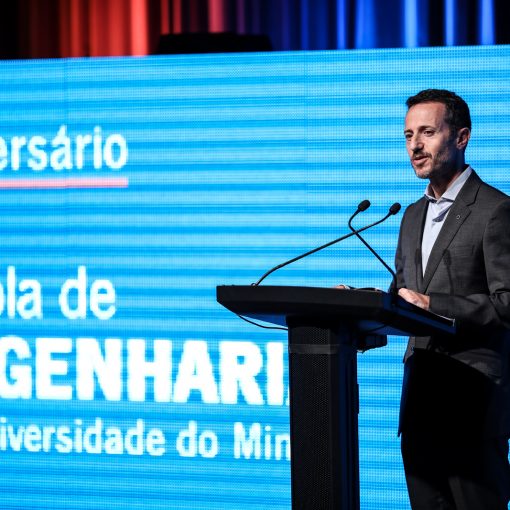
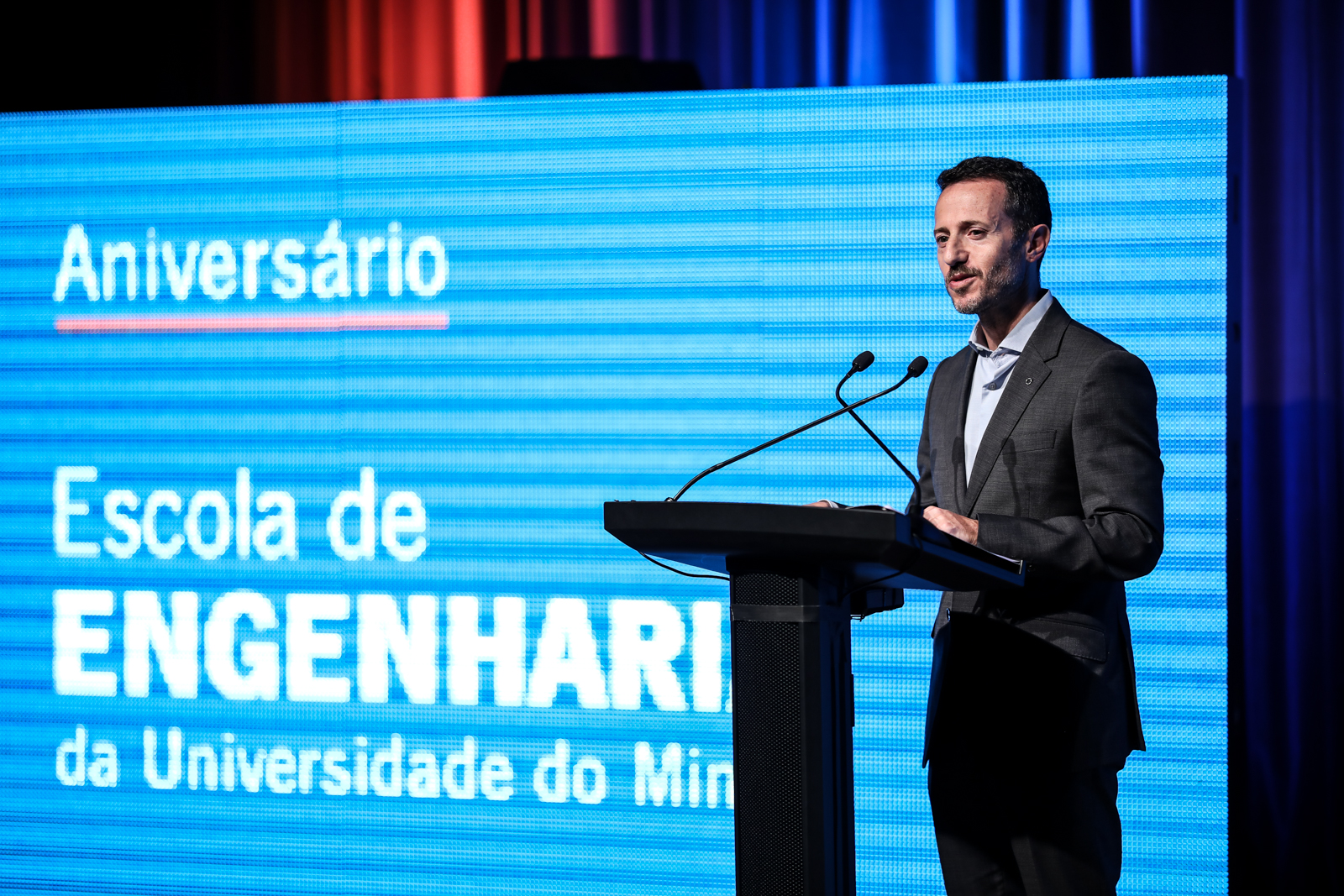
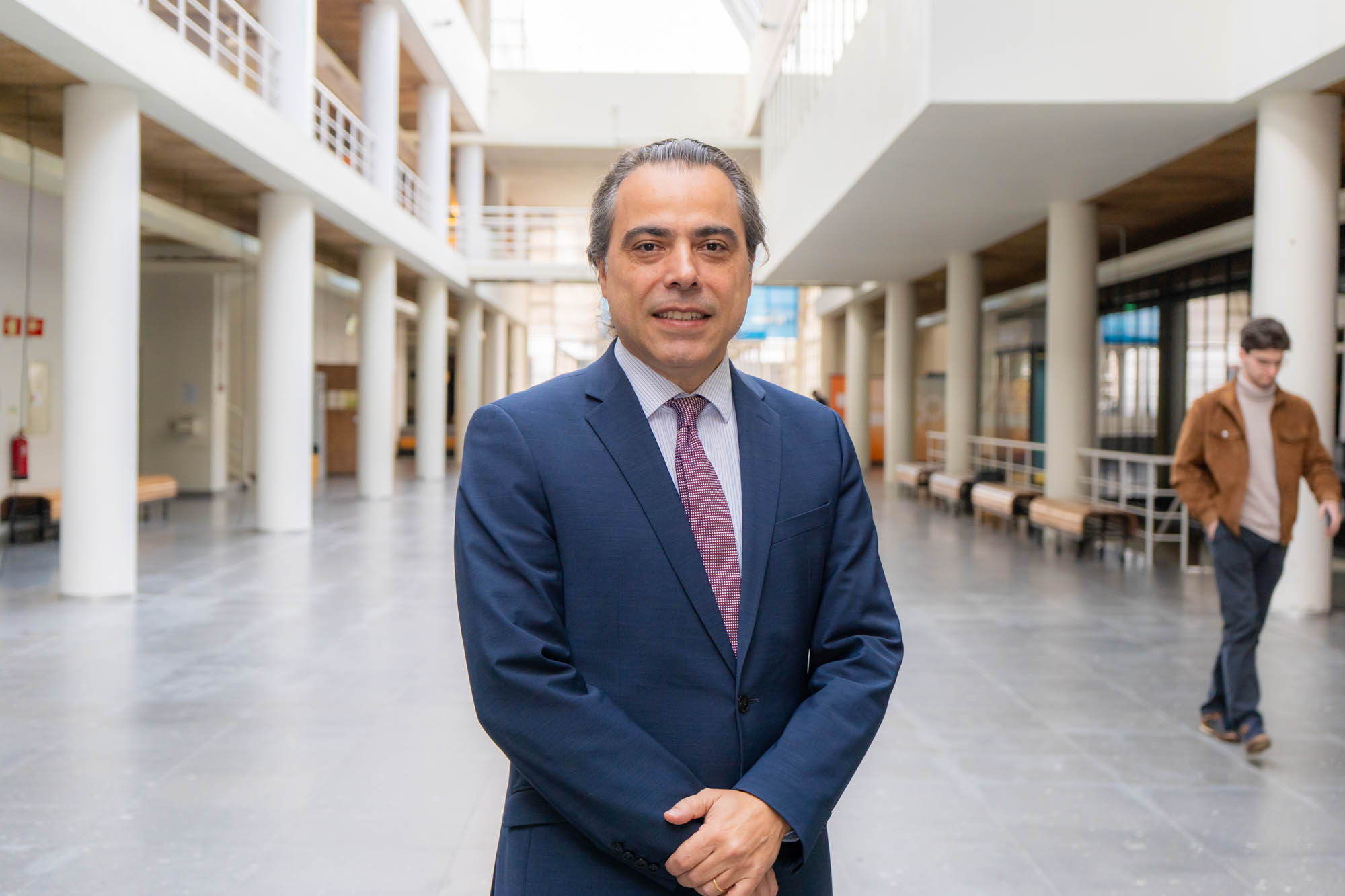
 A series of interviews with members of the School of Engineering’s new Advisory Board. In this edition, we interview Dr Ricardo Araújo, Mayor of Guimarães.
The Advisory Board of the School of Engineering at the University of Minho (EEUM) acts as an advisory body to the School’s governing bodies on matters of strategic planning. Comprising nine external figures of recognised merit in their respective fields, its mission is to provide guidance on matters relating to teaching, research and engagement with society.
1. How did you receive the invitation to join the Advisory Board of the School of Engineering at the University of Minho (EEUM), and what significance do you attach to this role as Mayor of Guimarães?
I accepted the invitation with great pleasure and with a sense of the responsibility it entails. The School of Engineering at the University of Minho has been in Guimarães for nearly fifty years, and over this time, it has become one of the institutions that has contributed most to what the municipality is today. It is part of the city’s identity, alongside its history, its heritage, and its industrial culture.
Furthermore, it plays a fundamental role in educating people and in generating knowledge and innovation. For those who study there and for the entire region.
For me, joining this Advisory Board is not a formal institutional representation; it is the recognition that the City Council and the School share a common agenda for the future. It is an opportunity to put the region’s vision at the service of the School’s strategy and, at the same time, to bring the School’s expertise closer to the City Council’s decision-making.
2. Given that Guimarães has such a close relationship with EEUM, how do you view the role of the City in a strategic advisory body such as the EEUM Advisory Board?
The municipality’s role is that of a close, demanding, and accessible partner. Close because EEUM is, first and foremost, an institution of Guimarães: its main campus is in Azurém, a large portion of its ten thousand students live and study here, and most of its more than ten R&D centers are based here. Demanding because the Advisory Board must be a space where the School is challenged to view the region as one of its core purposes and not merely as a backdrop. And also accessible because the City Council has tools that can amplify the impact of the decisions made by this Board.
3. In your view, how can the presence of the Mayor of Guimarães on this body strengthen the connection between EEUM’s academic vision and the needs of the region?
I was elected with very clear priorities: housing, mobility, innovation, and economic development. In all these areas, in different ways, EEUM can make a valuable contribution.
Engineering today solves people’s concrete problems. Housing, mobility, energy, water, industry, health—all the major challenges I face as mayor are, at their core, also engineering challenges. Bringing this agenda into the Council allows the School to align its research areas with real and urgent problems.
I advocate a model in which the city serves as the School’s “living lab.” I want to open Guimarães to the solutions that can be conceived here, such as testing mobility, materials, energy solutions, digital systems, and environmental monitoring tools. The Mayor’s presence serves, above all, to ensure that this bridge is not merely rhetorical, because there are those who make decisions and those who conduct research, and they are sitting at the same table.
4. As mayor, what contribution would you like to make to strengthen the ties between EEUM, the city of Guimarães, and its future development strategy?
The Guimarães City Council plays a cooperative role with the University of Minho and EEUM. It has invested to ensure we have good conditions and infrastructure for teaching and research. For example, the investment we are making in strategic projects, such as the Fábrica do Arquinho. But we cannot stop here. We must take the next step. In addition to supporting UMinho’s activities in the region, UMinho and EEUM’s activities must become the region itself. What does this mean? It means we are fostering synergies between what is done well here and what the region needs. But it also means accelerating the transfer of knowledge and skills from academia to society, starting with businesses. And I want this to be a lasting contribution.
This is structured in three areas. The first is the innovation pact I proposed, which involves a public commitment to organize cooperation around measurable objectives among the Municipality, the University, and other higher education institutions in the region, R&D centers, and the private sector. The second is the physical infrastructure that makes this partnership visible and firmly established—the Guimarães Space Hub at Fábrica do Arquinho is the first major example, but it will not be the only one. The third is a culture of return on investment in knowledge. For years, we have invested in creating the right conditions for research, but now is the time to ensure that this research translates into businesses, skilled jobs, and a better quality of life in Guimarães.
5. Over the next three years, how can the Municipality of Guimarães collaborate with EEUM to position the municipality as a leading hub in aerospace engineering and other strategic areas, leveraging innovation and technological development infrastructures—such as Fábrica do Arquinho—as spaces for attracting talent, experimentation, and fostering connections between knowledge, industry, and the local region?
For us, aerospace engineering is the most visible use case of a broader strategy. The Fábrica do Arquinho project—an investment of nearly twenty million euros—will bring together laboratories, R&D centers, startups, and companies in the sector in a single location, in close collaboration with EEUM. But the approach is replicable in other areas where the School is already strong, such as polymers, advanced materials, technical textiles, and artificial intelligence.
The Municipality’s contribution involves preparing the site (urban land, permitting, infrastructure), channeling European funding, opening doors to investors, and using its economic diplomacy to place EEUM in the right international networks. The School’s role is to bring in talent, science, and top-tier staff. Together, we can transform existing expertise into real economic value.
6. Given that the EEUM presidency is based on the Azurém Campus, how do you believe this institutional proximity can be leveraged to strengthen a joint agenda between the Municipality and the School, with greater decision-making capacity, coordination, and strategic impact?
The geographical proximity between City Hall and the Azurém Campus is a competitive advantage that few regions possess. I want to make full use of it. There are simple yet significant mechanisms, such as regular strategic planning meetings between the School’s presidency and the City Council’s presidency. This close and periodic collaborative contact between the two offices has already been taking place and has been fruitful. I also want Azurém to cease being a university campus within Guimarães and become an innovation district of the city, with EEUM as its anchor, but featuring housing for young researchers, qualified mobility, spaces for startups, and an urban connection to the historic center. This is a living lab project that can only be achieved through collaboration.
7. How can Guimarães, as a region with a strong industrial, cultural, and technological identity, help EEUM strengthen its connection to society and the impact of its work within the community?
Guimarães has three assets that many engineering schools would love to have right on their doorstep. It has a deep-rooted industrial culture, entire families who know what a factory is, and internationally competitive companies in textiles, footwear, and metalworking, among other sectors. It has a community that knows how to project itself and organize major events, given that we were European Capital of Culture, European City of Sport, we are European Green Capital, and in 2028 we will celebrate the 900th anniversary of the Battle of São Mamede. And it also has a strong civic identity, with a vibrant network of associations.
The School can anchor itself in all these assets. In fact, it does. If we look at the research units and ENESIIs linked to EEUM, we see a very strong complementarity between them and the business community. That is why it is essential to work with local industry to solve real problems. We can also use the city’s major events as platforms for science outreach. We can visit the municipality’s elementary and secondary schools to inspire future careers. The municipality helps open those doors.
We want EEUM and UMinho to have global ambitions, but their most immediate tangible reality is Guimarães; this is the area closest to them and the one they can transform most easily, making it, therefore, a desirable calling card for EEUM.
8. What priority initiatives do you believe should be developed jointly over the next three years to position EEUM as a driving force for innovation, regional development and the promotion of knowledge?
It is essential to establish processes and systems to ensure that cooperation with the region takes place not in a sporadic or ad hoc manner, but systematically. EEUM produces knowledge and human capital of the highest standard. It is important that bridges are built in these two areas to connect with businesses and civil society.
Our commitment is enshrined and structured within our programme, firstly through the innovation pact to structure cooperation, establish shared objectives and common goals. Then, the physical and organisational structures that underpin this action (such as the Fábrica do Arquinho in the aerospace sector, but also several others currently being developed). Next, a shared agenda for engagement and exchange with the region, whether through attracting investment, securing funding, or developing projects. And, through this set of initiatives, to transform Guimarães from the Cradle of the Nation into the Cradle of Innovation, turning it into a shared living lab, where schools and businesses use the region as a testing ground and hub for action in mobility, sustainability, materials and digital technology.