João Gaspar Cunha’s project envisages a new generation of neuroadaptive robotic partners
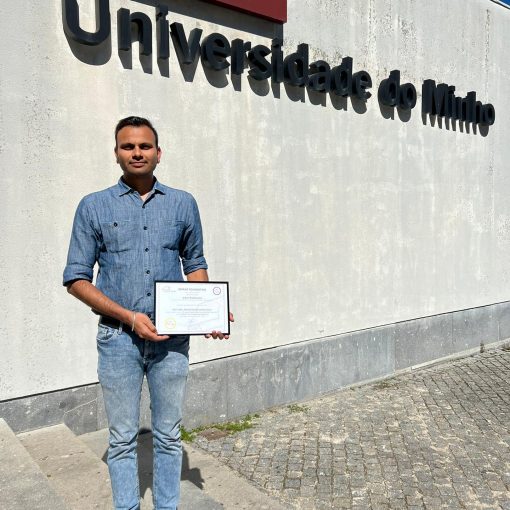
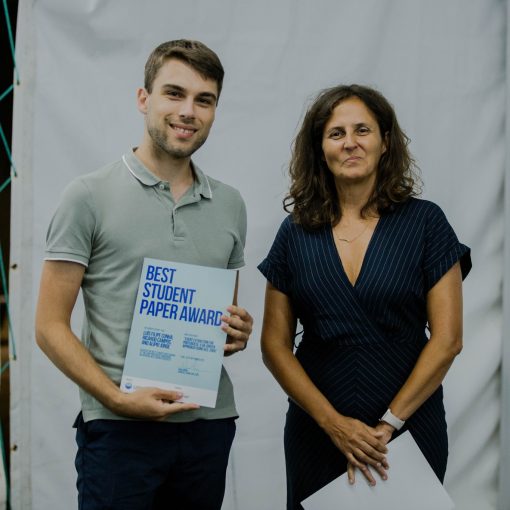
João Gaspar Cunha, a PhD student in Electronic and Computer Engineering at the University of Minho, won the ‘Best Innovation in HRI NeuroDesign Award’ at the international ‘IEEE RO-MAN’ conference held in the Netherlands. The award recognises pioneering projects in human-robot interaction, and in the final round of the competition there were 14 other participants from Canada, Spain, the USA, India, Iran, Italy and the Netherlands.
‘Doctoral work is sometimes thankless because it requires a lot of time and dedication, so I am very happy for this recognition, which is also for UMinho and Portugal,’ says João Gaspar Cunha. His award-winning study, ‘The neuroevolution of collaborative decision-making in robotic assistants,’ explores how robots can learn to collaborate naturally with humans.
The research applies principles of neuroevolution and neural field theory to create adaptive and interpretable systems capable of deciding when to help and when to act autonomously in shared tasks, he explains. Supervised by professors Estela Bicho and Wolfram Erlhagen (UMinho) and Raymond Cujpers (Eindhoven University of Technology, TU/e), the project aims to develop a new generation of neuroadaptive robotic partners, capable of fluid, human-like collaboration, shaped by the principles of the brain.
A native of Braga and aged 28, João Gaspar Cunha completed an integrated master’s degree in Industrial Electronic Engineering and Computers at UMinho. He is currently pursuing a PhD in the same field at UMinho and TU/e, with support from the Foundation for Science and Technology, and is conducting research at the Mobile and Anthropomorphic Robotics Laboratory of the Algoritmi Centre, at the UMinho School of Engineering in Guimarães. He was a researcher at the Collaborative Digital Transformation Laboratory (DTx), a guest lecturer at the Polytechnic Institute of Cávado and Ave (IPCA) and has participated in conferences and published articles in international scientific journals.