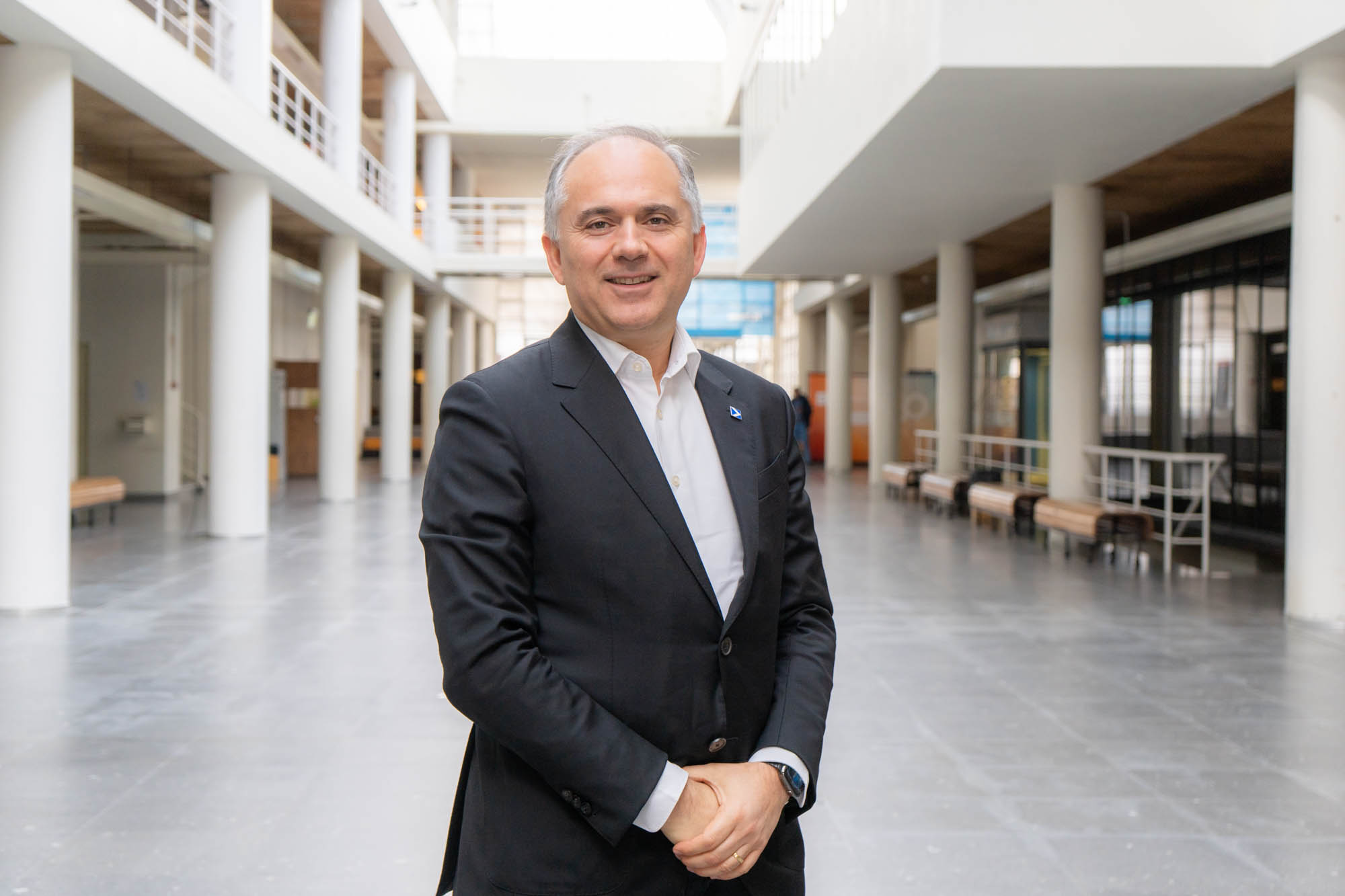
 Cycle of interviews with the members of the new Advisory Board of the School of Engineering. In this edition we interviewed Eng. António Rodrigues, CEO of the Casais Group.
The Advisory Board of the School of Engineering of the University of Minho (EEUM) is the advisory body of the School’s governing bodies for matters of strategic definition. Composed of nine personalities external to the institution, of recognized merit in the areas of their activity, their mission is to pronounce on matters of a pedagogical, scientific nature and interaction with society.
1. What motivated you to accept the invitation to join the Advisory Board of the School of Engineering of the University of Minho and what meaning do you attribute, both personally and professionally, to this connection?
I accepted the invitation because I believe that the connection between companies and academia does not happen by chance. It has to be intentional, worked on and goal-oriented.
The University of Minho has a very close relationship with the region, with the business fabric and with areas critical to the future of the economy. For me, this connection has a very strong personal and professional meaning, because it brings together two dimensions that I consider essential: the creation of knowledge and its practical application.
Companies need academia to think further, research, train talent and challenge the way we do things. The academy also wins when it has a close relationship with companies that test, apply and validate knowledge in a real context. This contribution is useful for both sides and, above all, for society.
2. EEUM is a School with a strong tradition, but also with a clear ambition for the future. In your perspective, what role can an external member of the Advisory Board play in connecting the academic vision of the School with the concrete needs of society and the economy?
An external member can help anticipate trends and needs that companies, the economy and society will feel in the coming years.
Innovation and technological development respect long cycles. Often, what begins as research today will only have an economic and social impact several years from now. Therefore, it is essential that academia has regular contact with those on the ground, with those who feel the changes in the market, the constraints of companies, the evolution of professions and the new needs of society.
The EEUM will have a lot to apply the knowledge it develops, if – locally and internationally – there are natural recipients of this work. Companies can be these recipients. They can also be spaces for testing, validation, and learning. This is a very important role of an Advisory Board: to help bring the academic vision closer to the concrete needs that are emerging.
3. In your opinion, what kind of relationship should be built between the School of Engineering and the external members of the Advisory Board so that this body contributes effectively to the School’s strategy, and does not have just a symbolic role?
The relationship must be participatory, regular and associated with the relevant moments of decision of the School itself.
An Advisory Board only adds value if it is called upon to discuss concrete issues, with an impact on the strategy, the training offer, research, the connection with companies and the international affirmation of the School. It should not be just a space for formal listening. It should be a useful space for reflection, where difficult questions are asked, priorities are tested and opportunities are aligned.
If external members are involved in topics that then translate into the EEUM’s agenda, the contribution can be very relevant. For the School, because it gains external reading and contact with real needs. For companies, because they can help direct knowledge, talent and research to areas where there is concrete impact.
4. As a business leader and member of the Advisory Board, how would you like to contribute to the development and affirmation of the EEUM in the coming years?
I would like to contribute by bringing a practical perspective on the challenges that companies face and on the skills that will be needed in the coming years.
The EEUM has areas of intervention that are key to the challenges of society and the economy. It can assert itself as an international reference in specific fields, especially in those where it manages to intersect research, training and practical application with companies that work on these topics every day.
It is this joint training that creates knowledge of excellence. When academia and companies work on real problems, with technical demands and a vision of the future, conditions are created to train better talent, develop better solutions and strengthen the competitiveness of the territory.
5. Given the current challenges of Engineering training, in which areas do you think the experience of the Casais Group can contribute in a more relevant way to bring EEUM students closer to the real demands of the professional context?
Our experience can contribute above all to the connection between technical training, technological transformation and operational reality.
Engineering is changing very rapidly. The introduction of technology, data, digitalization, artificial intelligence, automation, new materials and new construction processes is profoundly changing functions in companies. This means that initial training is still essential, but it is no longer enough for the whole of working life.
We need complementary training programs, namely in a postgraduate regime or equivalent formats, which do not necessarily have to be degree conferrers, but which allow professionals to update throughout their careers. This is an area in which I see a lot of potential: bringing students and professionals closer to the demands of companies, with practical, up-to-date content linked to the concrete challenges of the industry.
6. In the coming years, the EEUM intends to strengthen its connection with society and the business community. What concrete opportunities do you see to deepen the collaboration between the School of Engineering and the Casais Group, in a three-year horizon?
I see very concrete opportunities in areas such as artificial intelligence, robotics, automation, energy efficiency, new materials and new construction processes.
Construction continues to be an industry where many activities are done manually, with little repetition and with great variability. At the same time, we have technologies today that can change this reality: 3D printing, additive manufacturing, robotization, digital twins, intelligent control systems, sensors, data analysis and new energy efficiency solutions.
There is also a strong opportunity in adapting materials and processes that already exist, but that were not competitive or scalable before. Technology can make viable solutions that, a few years ago, seemed too expensive, slow or difficult to implement.
In this three-year horizon, the collaboration between EEUM and the Casais Group may include pilot projects, applied research, advanced training programs and demonstration spaces where innovation is tested in a real context.
7. Taking into account the experience of the Casais Group in areas such as industrialization, digitalization, sustainability and talent management, what practices or learnings do you consider most relevant to share with the EEUM to support its strategic evolution?
We can share our journey of transformation and, above all, the obstacles we encountered along the way.
In digitalization, one of the biggest learnings is that technology only creates value when it changes processes, behaviors, and decisions. It is not enough to introduce tools. It is necessary to change the way we plan, measure, control and collaborate.
In sustainability, we can share our vision on the circular economy and the need to think about buildings for change. Buildings should be designed with greater adaptability, greater resource efficiency and lower impact throughout the life cycle.
In talent management, there is also an essential point – people evolve when they are exposed, in a structured way, to new experiences, new challenges and new contexts. Technical training is fundamental, but it is not enough. We also have to train human skills – collaboration, communication, critical thinking, responsibility, leadership and adaptability. We need good professionals, but also good people, capable of growing in increasingly demanding environments.
8. If you had to point out two or three priorities for collaboration between EEUM and the Casais Group for the next three years, which ones would you highlight and what impact would you expect from these initiatives?
I would highlight three priorities:
The first is the creation of complementary training programs and postgraduate courses oriented to the current challenges of engineering and construction. The expected impact would be very clear – updating skills, better preparing professionals for technological transformation and creating a continuous learning model. Ideally, many of our professionals should go through these programs, and some should do several throughout their careers.
The second is the materialization of the CCS – Center for Sustainable Construction as a reference in sustainability, industrialized construction and application of new technologies. Robotics, automation, data and new production processes can make a very relevant difference here. This center can be a space for applied research, demonstration and connection between academia, companies and society.
The third priority is research directed to the big issues that Europe needs to solve: building more, with better quality, more productivity and less environmental impact. This is particularly important in the rehabilitation of existing buildings, because this is where most of the built heritage is located and also a very significant part of the future needs for intervention.
If we can align these priorities, the collaboration between EEUM and the Casais Group can generate impact – better training, better applied research, more productivity, more sustainability and greater responsiveness to the challenges of the economy and society.